Poco F5 / Redmi Note 12 Turbo long-
term review
Introduction
Poco's F-series devices have, for the past few years, been its entrants into the 'flagship killer' realm, and recently the family has been split into two - a more affordable vanilla version and a Pro model that is the real 'flagship killer' with a higher-end chipset.
That's still true this year, but there's an interesting twist, which we've noticed ever since the Poco F5 and Poco F5 Pro have been announced: you are way more interested in the vanilla F5 than the F5 Pro, and we assume that's down to each device's value proposition. The F5 Pro's isn't bad, don't get us wrong, but compared to past F-series Pocos, it's not great either.
On the other hand, the Poco F5, on paper, seems to tick a lot of boxes for a lot of people, so we were eager to see how it behaves in day-to-day life over an extended period of time during which we've used it as our one and only smartphone. Hence, this long-term review was born.
It's also important to note right off the bat that the Poco F5 is identical to the Redmi Note 12 Turbo, and is sold under that name in some markets. We gave up trying to understand Xiaomi's naming and distribution shenanigans a long time ago, but we feel like this is important information you need to know going into this review. For the purposes of simplicity, we'll refer to the phone as Poco F5 since that's the shorter name, but know that everything we say about it applies to its twin as well.
With that out of the way, let's also note that the F5 stands out as being the first phone powered by the Snapdragon 7+ Gen 2 SoC, one that, on paper, should deliver most of the performance of an 8-series Snapdragon, without the huge price markup those entail these days. Best of all worlds, then? We'll see. It has been a while since what is technically a mid-ranger got us this excited, delivering in theory such a well put together package for such a low price - the most recent Redmi Note non-Turbos haven't, even though their predecessors a few years ago did.
So let's jump right into it and see how the Poco F5 / Redmi Note 12 Turbo fares in our extensive subjective testing. Join us over the next few pages and we'll let you know how happy we've been with it.
Design, handling
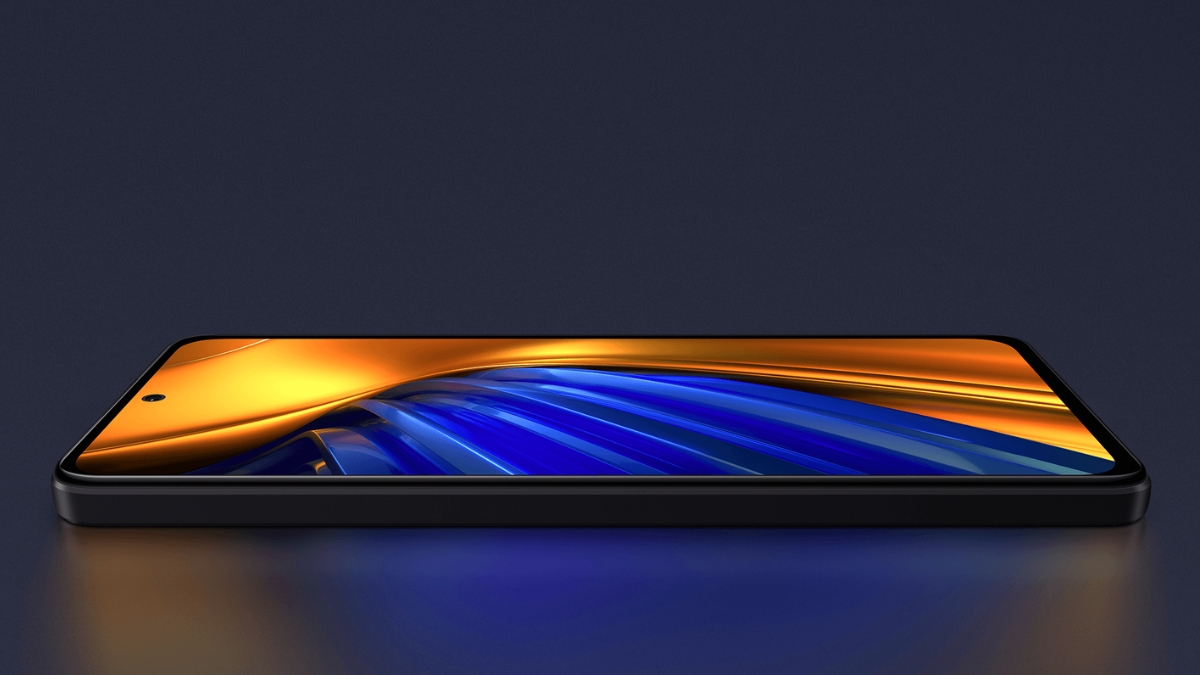
Normally with flagship devices, this is the area where we say something along the lines of "it looks like a modern Android smartphone, and they all kind of look the same these days". The Poco F5, on the other hand, looks better from the front than a lot of much higher-end devices, and that's thanks to a very simple, but often overlooked factor in the mid-range space.
Bezels. They are almost symmetrical. They're not, but they're so close that unless you actually measure each one, it always feels like they are. In reality, the side bezels are identical to each other and the slimmest, then the top bezel is a tiny bit fatter, and the bottom one is a tad larger still - but if we didn't tell you to look closely, we'd wager you wouldn't have noticed.
This gives the Poco F5 a very high-end look from the front, one that's missing in most other mid-range Android smartphones. Normal people you meet in day-to-day life will confuse it for a much more expensive device, and it's the first time that's occurred in quite a while. Let's just say, for comparison's sake, that this never happened with any of the Redmi Note non-Turbos we've reviewed long-term before.
But wait, there's more. The frame might be plastic, and yet, most people wouldn't be able to tell just by looking (we mean normal people who don't go hunting for antenna lines, mind you). It's also flat, and very obviously so, "like an iPhone" (a comment we received dozens of times). That's a good thing in the world of people who aren't addicted to smartphone news, by the way.
We like the look of the frame, but we most like how the screen meets the frame with zero sharp feeling in your fingers. Apple only learned how to do that for its Pro models this year, many months after the Poco F5 came out. Make of that what you wish, but it's still a fact.
Using gestures from the sides or from the bottom feels the best out of any phone without a curved screen that we've ever used. In fact, if all flat-screen phones were like this, we'd lose one of the main advantages that curved screens have, in this reviewer's opinion, which is exactly how smooth gestures from the sides and bottom feel.
So while at first glance the Poco F5's design isn't anything that special, hold it in your hand for even a few minutes and you'll be very positively surprised. With a little bit of caution when placing it, it can also 'stand up' both on its bottom and on its top. We're not sure anyone really needs this information, but we checked and it does.
The in-hand feel is great. The frame is matte, but because it's plastic, that doesn't automatically mean it's incredibly slippery, as it would be if it had been metal. It's still a little bit slippery, but nothing too dangerous. Handling is great for people with average or big hands, owing to the very mainstream screen size and width.
Of course, the usual caveat applies: if you have small hands, you'll struggle using it one-handed comfortably, but unfortunately, that's a reality for most phones these days, and sales numbers across the industry seem to imply that even people with small hands end up buying big phones. That extra screen real estate is hard to ignore, we assume.
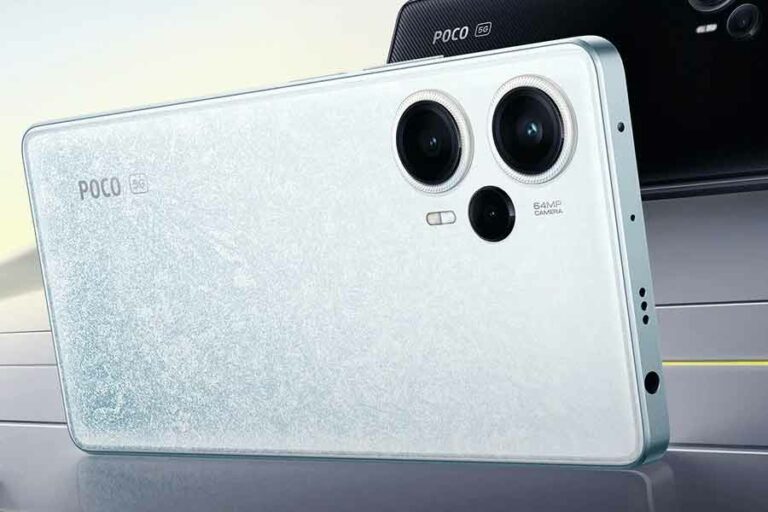
On the back, our review unit has a very interesting design. This colorway is called "white" but don't let that deceive you, as it's not your run-of-the-mill boring white. Instead, there are a lot of shimmering patterns built-in, that almost look like ice or snow from some angles. It's a very interesting look and every single person who saw us use this phone has commented about that in a very positive fashion, regardless of their gender.
The two bigger camera islands have rings around them which seem (but aren't) almost semi-transparent from some angles, and they have a very nice design that elevates the phone's look some more. Of course, this might not be for everyone, so if you want something traditional-looking the black version is for you, or the blue one if you desire the middle-of-the-road option. The rings around the cameras are still there;however, they're most subdued in the black iteration.
Speaking of cameras, there are three individual circle islands for the three snappers, which is a design we much prefer to the huge monolithic camera islands that seem to be in fashion these days for some higher-end models. That said, if you place the phone in landscape mode and then look at the circles, you might get a 'robot face' vibe, with the two bigger ones being the eyes and the smaller one being the mouth. Or the nose, if your imagination created a mouthless robot. This can be cute or disturbing, it's up to you.
To create some semblance of symmetry on the sides of the smaller ring, you get the LED flash on the left (as you look at the cameras in landscape mode), and an inscription on the right. This time Poco went with something that makes sense: "64 MP camera". We still find these superfluous and pointless, but Poco is definitely on the right track, as this is miles better than the nonsensical text that adorned the F4 GT last year. Hopefully, at this rate, we won't have any useless text on the F6? We can dream, at least.
Build quality is flawless, and overall, while the design of the Poco F5 isn't something that's very far removed from the generic outline of a smartphone nowadays, it still has enough nice little touches to stand out - but not in a shouty way. More like - if you get one you'll appreciate the little things every day.
Vibration motor
Let's not mince words, this is one area where cost has been kept extremely low. The vibration motor is definitely not what we've been used to in recent times from Xiaomi / Poco / Redmi at this price point, but on par with some competitors' offerings. It's there, but its vibrations lack any sort of depth and oomph.
Haptic feedback settings
It's not great, and you can barely feel it and barely hear it, even on the highest possible setting of the "Haptic feedback level" slider, which is the worst combo you can possibly have. If you're used to the Redmi numbered series' vibration motors, this will feel similar, but it's a bit of a letdown considering how much emphasis Xiaomi and its sub-brands generally place on the higher-than-expected quality of their vibration motors. This is not one of those, plain and simple.
Speakers
The Poco F5's stereo speakers won't win any awards, but they get the job done. The sound is higher-pitched and slightly tinnier than what today's flagships are able to produce, and bass is almost non-existent (compared to higher-priced devices, which is not a fair comparison, let's acknowledge).
In terms of how loud they get, we'd say they are about one to two notches below the best speakers we've heard on mainstream slab-style flagship smartphones, which, considering the price differential, we think is quite a feat. You do need to bring the phone closer to your ears at a lower ambient sound level than you would with a handset that's twice the price, but the difference isn't big enough that we'd call this a downside.
We understand that to reach such price points, some compromises have to be made, and in terms of speakers, we feel like most people will be perfectly happy with them - we have other devices to compare side-by-side with, hence why we can discern differences that you probably won't, unless you're switching to this from a higher-end device, which is not a road that's much traveled we'd wager.
As usual in recent years with handsets from the Xiaomi / Poco / Redmi stable, the top speaker has two outlets, one is the earpiece and the other is on the top frame. This does mean that when you take calls the voice of the person you're talking to will 'leak out' somewhat, but when you're listening to media or are talking on speakerphone that means the sound is much fuller and the two speakers are closer in terms of volume and quality.
Biometrics
The Poco F5 has a side-mounted fingerprint scanner, embedded in the power button, and it's on par with the best side-mounted fingerprint scanners we've ever used. It's fast and it's incredibly accurate - in our experience, we got in upon the first try in about 98% to 99% of cases, which is just amazing. Some fingerprint sensors can be exceedingly frustrating to use, this one has given us zero frustration throughout our extended time with the phone. There's nothing bad we can say about it, it's just that good.
The usual note applies here regarding side-mounted sensors. Make sure that, when you enroll a fingerprint, you cover as much of your finger's surface area as possible - the sensor is thin, and you won't always be touching it with the same part of your finger. If you do that, like we did, we don't think you'll ever have any problem with it.

You can choose to unlock upon a touch of the power button, or a press. We always go for the latter option since the former results in many accidental unlocks for us, but of course you're free to choose whatever suits you. Just keep in mind that unlocking upon a mere touch is the default, so if you want to switch you'll need to dive into Settings. We're used to pressing power buttons on other devices to wake them up, and so here it's incredibly seamless to press and then be on the home screen within an instant.
Biometrics settings
There is face unlocking too, as you'd expect, but as with most other Android smartphones out there, it only uses the camera and is thus way less secure than fingerprint authentication. You even get a warning about this when you're about to scan your face. Although it's not mentioned anywhere, and there's no specific setting for it, we checked and face unlocking won't happen if your eyes are closed. So there's no chance of someone unlocking your phone while you're sleeping. At least not with your face, there have in the past been demonstrations showing it working with a picture, so do keep that in mind.
Brightness
The Poco F5 has an AMOLED screen with Xiaomi's favorite size - 6.67". It's not amongst the brightest out there, which is probably unsurprising given how it's priced, but we're happy to report that it pumps up adequate amounts of brightness even on a bright sunny day. Sure, the screen won't be as easy to see as indoors, but it's perfectly fine and you won't need to chase a shaded place in order to do anything on the phone.
The 963-nit top brightness in Auto mode that we've tested in our normal review puts it around what you'd expect from a midranger these days, and it's notably brighter than last year's Poco F4 GT, for example, which is great to see (excuse the pun). It also towers above the fan-favorite Nothing Phone (1), for what it's worth, with about a third more brightness. While not mind-blowing, it will definitely do the job in day-to-day life.

At the other end of the brightness spectrum, things aren't so bright - or rather, they are, and too much so. Let's untangle our contrived wording here: in pitch black environments, you might find, like we did, that the screen remains just a tad too bright for comfort even on the lowest possible brightness. Unfortunately, there's nothing you can do about that, since Xiaomi still doesn't include the Extra dim feature that's been part of Android for a while now.
Choosing the dark mode at night does alleviate the issue somewhat, but when you're confronted with a white background - say, on a webpage - your retinas might still ache. Then again, perhaps we're just being too sensitive and you'll be fine, there's no way for us to tell what your particular reaction will be. Just know that we've seen many displays on phones recently that can and do go dimmer at night, this is among the ones that remain the brightest.
The auto-brightness algorithm on the Poco F5 has been pretty much perfect, with minimal manual adjustments required, and all of the adjustments made being remembered for any subsequent encounters with the exact same level of ambient lighting.
This is how it should be, and a lot of other phones could learn a thing or two from this one in this respect - for example, we found the recently long-term reviewed OnePlus 11 incredibly frustrating in this regard, requiring constant manual adjustments even weeks into our use of it. The Poco F5 may be cheaper, but at this specific thing it's way better, there's no contest really. Its auto-brightness algorithm is just generally among the absolute best we've encountered in the past year or so, when most seem to have gotten worse than they were a few years back, for whatever reason. That's not going to be a problem here.
Screen quality, colors
The panel is very high quality and unless you have a flagship smartphone around to do side-by-side tests with, you won't find anything lacking, which is definitely commendable considering the inherent price delta.
Display settings
Colors are incredibly accurate in the Standard color scheme, which is tuned to the sRGB color space to perfection. There are some other options too, but they are (perhaps understandably?) way less color accurate - and this includes the default Vivid mode, which has whites that lean too much towards blue.
Color scheme settings
In the Advanced settings, you can fine-tune the red, green, and blue levels, as well as hue, saturation, contrast, and gamma, but since most content on the web is still optimized for sRGB, we don't know why you wouldn't just select Standard and never think about colors ever again. Or, if you don't care about accuracy that much, just pick Vivid or Saturated, whichever looks better to you. If you go with either of those, we suggest choosing the Warm color temperature preset to offset some of the bluish whites.
Refresh rate
120 Hz is standard these days, and the Poco F5 delivers. As usual with MIUI devices, we went into Settings and chose the "Custom" 120 Hz setting, as the default option will be at that point less. Your mileage may definitely vary here, but we like to test devices at the absolute best of what they can deliver, especially when it comes to refresh rate, which has a huge influence on the overall perceived smoothness.
Refresh rate settings
As with any other device nowadays, picking 120 Hz doesn't make it always be at that rate, it's just basically selecting the peak. The display isn't LTPO so it won't adjust in minute increments all the way down to 1 Hz. It will just be at 120 Hz most of the time, switching to 60 Hz when playing videos or when the screen is idle. It's definitely not the most complex system, but it gets the job done and as you'll see in the appropriate section of this review, battery life has been great even so.
Reading mode, Always-on display
As we keep saying in all of our long-term reviews, MIUI currently has the best blue light filter implementation on the market, and it's not a contest. The same is present on the Poco F5, of course, and it's called Reading mode.
If you're wondering what makes this the best, it's the amount of options you get. There's the "Classic" mode which behaves like most other blue light filters out there, giving you a slider for intensity, of course, but then there's also the "Paper" mode which introduces some texture/graininess in the mix, which is adjustable with its very own slider. This also lets you go black and white or pick "Light colors" which means desaturated colors. If you're struggling with putting down your phone throughout the day, give this a try - things will look less enticing for sure.
Reading mode settings
Of course, this isn't everyone's cup of tea, but we appreciate the fact that these options are there. If you just want to use the traditional blue light filter you can easily ignore all of the "Paper" stuff. Likewise, you can just ignore Reading mode altogether. A final note is that, unsurprisingly, this is schedulable too - either to come on automatically at sunset and turn off at sunrise, or with a custom interval.
The Always-on display on the Poco F5 is one of the very few letdowns, at least so far. And that's for a simple, yet frustrating reason: its name is deceiving, as it's not actually "Always-on". It only stays on for 10 seconds after you tap the screen, and then it's gone. Now, we would have used it like this anyway, since recently we haven't been big fans of 24/7 always-on displays, but we know that a lot of people love to have an always-on display actually be there, always on, and this one just isn't.
It's still baffling to us why some affordable phones from the Xiaomi / Poco / Redmi roster do this, as this is anything but the first model on which we've seen such behavior. We assume it's related to battery life, but why not just have the truly "always-on" option and caution people about battery life when enabling it? We wouldn't be able to tell you. It's also funny to see that the software was clearly designed with more options in mind, as there's a checkmark next to the only one here, as if this was supposed to be a list (like it is on higher-end Xiaomi phones), but in the end it ended up with the lone choice.
Always-on display settings
While we don't like this situation, the Always-on display itself is among the most customizable on the market, and for that it deserves to be praised. You can pick a myriad of options for what you will see: custom images, analog and digital clocks, text, as well as a digital clock with an image above. You are unlikely not to find one that suits you.
Performance, smoothness
The Poco F5 is powered by Qualcomm's Snapdragon 7+ Gen 2, and it's the first time we've long-term reviewed a device with this chipset. The name strongly implies it's just one step below the Snapdragon 8 series SoCs, but from past experience, that's not always a given in real life as well. In this case, however, it totally is. This chip very positively surprised us, as 90%+ of the time it feels like a flagship chipset in how fast it is.
The only slowdowns we've noticed are when you try to do other things while the Play Store is updating or installing apps, and when you have a ton of heavy apps open at the same time. But, even in those cases, the slowdown isn't of the "crawling to a halt" variety, it's more like - only at these points does this phone ever feel like a midranger.

At any other time, and do bear in mind that this reviewer doesn't game, the Poco F5 feels almost indistinguishable from a handset with a Snapdragon 8 series chip inside. And that's fantastic to see at this price.
When it comes to smoothness, it's close to the flagships while not matching them. And yet, this is the smoothest phone we've ever tested with a chip that isn't in the Snapdragon 8 or Dimensity 9xxx lines. We consider that high praise considering the price point and the fact that this SoC really does take you 90% of the way to flagship-land for a fraction of the cost. So we have to commend Redmi and Poco for choosing it for this phone, it suits it very well, and unless you're a heavy multitasker or a heavy gamer, we don't think you'll ever be left wanting more.
Battery life
Battery life has been great, but you'll have to take our word for it, since MIUI 14 on the Poco F5 doesn't allow us to get a screen on time number from the time the phone is unplugged at 100%. That's a pretty standard feature on almost all skins, and used to be present in past versions of MIUI, but has been removed for reasons that escape us. It just makes no sense, Xiaomi. That number would help us prove how good the battery life is on your phones, because it is generally so across the entire portfolio.
And especially so here. We never needed a midday top-up with our use case - not once. The F5 always took us to the end of the day, and usually with about 30% battery left. We only once saw it drop to about 20%, but that was an outlier day with loads of mobile data connectivity and GPS navigation.
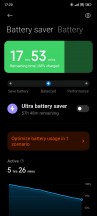
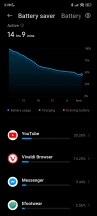
No Screen on time number
Normally, our use case involves about 12-16 hours off the charger, primarily Wi-Fi 6 connectivity, with about an hour or so of 5G mobile data, 30 minutes of GPS navigation via Waze, Bluetooth always on and an hour or two of listening to podcasts via TWS earbuds, and an hour or two of phone calls via TWS earbuds. Please also note that the "5G battery saver" setting was left on, which is its default state. That said, we never got 4G instead of 5G in areas where we knew 5G was available. If that would have happened, we would definitely have turned it off.
The general caveat applies - if your use case is more extreme than ours, then you'll get less battery life, but unless you're a very heavy power user always on bad-signal mobile data, we don't think you'll have any issues getting through a day with this device.
And even if you do need a quick top-up, it is actually pretty quick, as the F5 charges at 67W maximum for a time from zero to hero of about 47 minutes. Half an hour of charging gets you to 83%, which is pretty impressive for this price point, but of course there are faster-charging devices out there, we won't pretend like they don't exist. And yet, for most people, the F5's charging speed will be more than adequate. For those switching from midrange Samsungs or the Pixel a series, it will seem mind-blowingly fast.
Unsurprisingly since it is as affordable as it is, the F5 doesn't have wireless charging, but we think the wired charging speed more than makes up for that. Let's consider that had that been put in, it would have either made the phone more expensive, or forced the company to cut some other corner somewhere else.
Conclusion
The Poco F5, also known as the Redmi Note 12 Turbo in some markets, is among the highest performing and smoothest mid-range smartphones out there at the moment. In fact, it may just take the crown, if your definition of mid-range is similar to ours, namely devices that aren't using Qualcomm's or MediaTek's top line SoCs - the Snapdragon 8 series and Dimensity 9xxx, respectively.
That makes sense when you look at the spec sheet and see the Snapdragon 7+ Gen 2 in there - after all, 7 is right under 8, so the difference shouldn't be huge. And in this case it isn't, but we were still positively surprised since in the past, Qualcomm's 7 series (be that 7 Gen x or 7xx) employed a sneaky marketing trick with the naming, making you assume performance almost on par with the top of the line, when what you were really getting didn't live up to those expectations. We're happy to see that this has finally been rectified in the latest 7 series iteration.
So, there's that. You'll be hard pressed to find a smoother or higher-performing mid-ranger out there right now (we want to stress that we consider 'flagship killers' with higher-end SoCs a different category altogether, slotted in between mid-rangers and true flagships). This is in fact the smoothest phone we've ever reviewed long-term, of those that don't run a Snapdragon 8 series or Dimensity 9 series SoC.
Performance is indistinguishable from the flagship tier more than 90% of the time for day to day tasks, and the only slowdowns occur when you're jumping between multiple heavy apps or when updating apps and trying to run a heavy one at the same time. Otherwise, if you hand the Poco F5 over to a 'normal person' off the street, someone who isn't connected to mobile world news all the time, they will undoubtedly assume that it is higher-end than it actually is.
The screen is bright enough to be very usable even on sunny days outdoors, although it doesn't get as dim at night as we would find comfortable - but of course, you might not care about that. Speaking of the display, the auto brightness algorithm on offer here is among the best we've encountered in the past year, and at this price point, that's certainly commendable.
The speakers aren't the best ever, but are good enough in most conditions, while the vibration motor is an area where money was obviously saved, but it still does the job - it just feels a bit 'soulless', for lack of a better term. The fingerprint sensor is up there with the best side-mounted ones we've ever encountered, and battery life has been great - that's one step removed from 'outstanding' in our book, and it's high praise.
Charging is fast enough, even if not record-breaking (not even record-breaking for a mid-ranger), and people switching to this phone from an iPhone or Pixel or Galaxy will definitely be impressed. The lack of wireless charging is something we're always willing to overlook at such a price point, but your views on that topic could differ of course.
MIUI 14 may or may not be your cup of tea, depending on how many other MIUI-running devices you've had in the past and how you feel about very heavy Android skins, of which this is definitely one. We've handled quite a few MIUI handsets recently and find the UI rather stale at this point in time, with minimal design changes between versions. The upcoming HyperOS based on Android 14 will undoubtedly make it to the Poco F5 at some point, but don't expect it soon - Xiaomi and its sub-brands take their time with major updates, and this is definitely something you need to keep in mind.
Likewise the monthly security updates only arrive once every two months, which is still better than what the situation used to be for mid-rangers in the Xiaomi stable even one year ago, but competitors do better and this is just another thing that you need to be aware of, so that it's not a bad surprise once you get the phone.
The cameras are a mixed bag. The main shooter seems to be carried over from last year's Poco F4, but it produces nicer images than that phone for whatever reason, and it has OIS, so we think it will do the job very nicely for most people in all conditions, while of course not being able to compete with cameras in flagship devices costing three times as much. The 2 MP macro camera is a trend we really hoped would die this year, but there are still holdouts - we assume Xiaomi had a few million of them collecting dust in a warehouse somewhere, so you get one here, which you can feel free to ignore.
The ultrawide is at best decent during the day, and pretty much unusable at night. This is clearly another cost-cutting exercise, and we'll be honest: we're growing very tired of these 8 MP sensors at any price point above half of what the Poco F5 is going for. This should have been better.
In the end picking the Poco F5, or any other smartphone, is a matter of personal preference - what you prioritize and what you can live without. There is no perfect device out there, and especially at mid-range prices it's impossible not to have compromises. As always, we tried our best to bring you a very detailed look at our time with it, in order to help you make an informed decision as to whether this is the one for you or not, regardless of what your specific priorities may be.
For what it's worth, we've enjoyed our time with the Poco F5 more than we have with any other mid-ranger we've ever reviewed long-term, and think that, with realistic expectations considering its hardware innards, the typical Xiaomi / Poco / Redmi software situation and price, it will be a joy for anyone to use.





Comments
Post a Comment